

Spanish-English · Meets OHA training requirements
Turn your Spanish and English into a health care career, no college degree required.
This 64-hour program meets the Oregon Health Authority (OHA) training requirement to become a Qualified or Certified health care interpreter, builds your skills through weekly one-on-one practice with an instructor, and walks you through applying to the OHA registry.
Developed with the OSU College of Health and funded by Eastern Oregon Coordinated Care Organization (EOCCO).
📅 Next cohort: May 10 to July 16, 2027. Online with in-person sessions (tentatively in Roseburg). Need a language proficiency test? Request it at least one month before the start date.
If you speak Spanish and English, you already have the hardest skill to learn. This training gives you the professional skills and the Oregon credential to use it in health care.
Oregon's Qualified credential requires a high school diploma or GED, approved training and proof of your language skills.
Since July 2022, Oregon health care providers paid with public funds must work with interpreters on the OHA registry, with limited exceptions.
Interpret in hospitals, clinics and other health care settings, in person or remotely.
The course covers how freelance and employee work differ, plus networking to find your first assignments.
Did you know?
$60,170
Median annual pay for interpreters and translators in the U.S. (U.S. Bureau of Labor Statistics, May 2025)
This training is a great fit if you're:
Oregon has two health care interpreter credentials. This training meets the training requirement for both.
Step one
Qualified Health Care Interpreter
Step two (optional)
Certified Health Care Interpreter
Both credentials: listed on the OHA health care interpreter registry, valid for 4 years, and renewed with 24 hours of OHA-approved continuing education (6 ethics, 6 skills, 12 other).
AT LEAST 1 MONTH BEFORE YOU START
SHOW YOUR LANGUAGE PROFICIENCY
Use an accepted proof from the OHA proficiency list, or add the $108 proficiency test when you register.
MAY 10 TO JULY 16, 2027
COMPLETE THE 64-HOUR TRAINING
Work through weekly online modules, practice one-on-one with your instructor, and attend live virtual and in-person classes.
WITHIN 1 YEAR OF FINISHING
APPLY TO THE OHA REGISTRY AS A QUALIFIED INTERPRETER
Submit your application with your training certificate, ID, proficiency proof and diploma or GED. The course walks you through it. After 1 year, you'll need proof you've been working as an interpreter; after 2 years, you'll need to retake the training.
OPTIONAL, WHEN YOU'RE READY
PASS A NATIONAL EXAM TO BECOME CERTIFIED
Take an approved certification exam, such as CCHI or NBCMI, then apply to OHA as a Certified interpreter.
EVERY 4 YEARS
RENEW YOUR CREDENTIAL
Complete 24 hours of OHA-approved continuing education and renew with OHA.
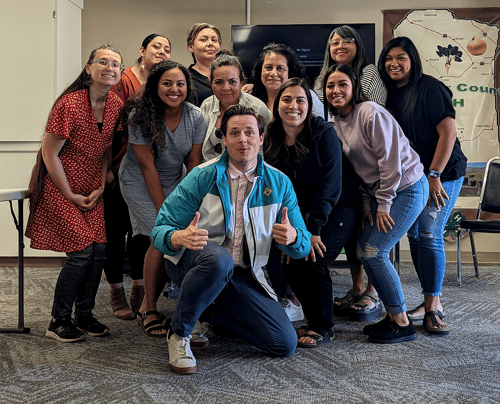
🗣️ Weekly one-on-one practice
Practice interpreting with your instructor every week and get feedback on your performance.
🏫 Live classes, online and in person
Self-paced online modules, short live virtual classes and a few in-person class days.
📘 Textbook included
The Interpreter's Rx is included in the price.
💼 Registry and career guidance
Help applying to the OHA registry, plus insight on freelance vs. employee work and networking.
Access the on demand webinar and discover how the Health Care Interpreter program can jump-start your career as a Spanish-English health care interpreter.
Eight modules cover NCIHC interpreter ethics, anatomy and medical terminology in English and Spanish, and the skills OHA expects.
You'll also practice sight translation, remote interpreting and basic written translation.
Learn from a working interpreter
Felicity Ratway, PhD
Program coordinator and instructor
$1,150
($143.75 per module), textbook included
$805 Eastern Oregon rate
For students in Baker, Gilliam, Grant, Harney, Lake, Malheur, Morrow, Sherman, Umatilla, Union, Wallowa and Wheeler counties
Optional language proficiency test: $108
To enroll, you'll need:
Both need 60 hours of OHA-approved training, proof of language proficiency and a high school diploma or GED. Certified interpreters have also passed an approved national certification exam, such as CCHI or NBCMI. This course meets the training requirement for both.
No. OHA's Qualified credential requires a high school diploma or GED, 60 hours of approved training and proof of proficiency in English and Spanish. To become Certified, you also pass a national certification exam.
Complete OHA-approved training like this course, prove your language proficiency, pass a national certification exam, then apply to the OHA registry. You can apply as Qualified first and become Certified later.
You need proof of English and Spanish proficiency before you start. See OHA's list of accepted proof. If you don't have accepted proof, choose the $108 proficiency test when you register, and request it at least one month before the start date.
Both. Most of the work is self-paced online, with weekly one-on-one practice, short live virtual classes and a few required in-person class days. In-person sessions for spring 2027 are tentatively planned for Roseburg.
Apply within 1 year of finishing. Between 1 and 2 years, you'll need proof you've been working as a health care interpreter. After 2 years, OHA requires you to retake the full training.
The course covers core skills the national exams test, including ethics, medical terminology, consecutive and simultaneous interpreting and sight translation. You'll register for and take the CCHI or NBCMI exam separately.
Qualified and Certified credentials last 4 years. To renew, complete 24 hours of OHA-approved continuing education: 6 hours of ethics, 6 hours of skills and 12 hours on other approved topics.
Yes. Students in 12 Eastern Oregon counties pay $805 instead of $1,150, thanks to funding from EOCCO.
Want a preview? Watch the free on-demand webinar about the training.
Bilingual and want to support your community in other ways? Explore community health worker training.
Questions? Email Felicity Ratway at ratwayf@oregonstate.edu.


“OSU’s Healthcare Interpreter Training Program allows participants the chance to experience a variety of possible scenarios one might encounter in the field. Felicity and Ryan really listened and understood my goals as an individual. They highlighted my strengths and encouraged me to challenge myself in areas where I needed improvement. Our cohort had plenty of opportunities for both one-on-one and group practice sessions, and the hybrid online/in-person model meant that attending classes was more easily accessible to me as a working parent. OSU’s program gave me a strong foundation to be the kind of professional I strive to be as a healthcare interpreter.”