
Earn a technical writing certificate from Oregon State University, 100% online.
Learn to write the manuals, SOPs and documentation people rely on, with feedback from an OSU writing instructor on every weekly assignment.
No degree or experience required. No set class times or live meetings. Take one course for $499, or all five for the certificate, and start free with our Intro to Technical Writing.
Wondering which kind of technical writer you could be? Take our free 3-minute quiz.
Step 1
Try It Free
The Free Intro to Technical Writing is self-paced, about 2 to 10 hours. Write your first technical memo and see if the career fits you.
Step 2
Take One Course
$499 (+$70 registration fee). Four weeks of instructor feedback and a finished piece for your portfolio.
Step 3
Earn the Certificate
All five courses: 160 hours of instruction, 16 CEUs and a professional online portfolio.
Many people start with the free intro to get a feel for the work. Others jump straight into a single course.
Either way, every course you take counts toward the full certificate, so you can build at your own pace.
Plenty of programs teach technical writing. Here's what makes learning it at Oregon State different.
A Real Editor Reads Your Work Every Week
OSU writing instructors give feedback on every weekly assignment, so you know what works and how to fix what doesn't.
Built for People in Technical Fields
Lab techs, nurses, engineers and quality specialists already write procedures. This program gives you the method, and the portfolio to prove it.
A University Certificate, No Gatekeeping
No degree, prior writing job or application required. Fully online and asynchronous, so it fits around work and family.
A Portfolio, Not Just a Certificate
Every course produces real work. The final course turns it into a WordPress portfolio you can send to hiring managers and clients.
 This program isn’t just coursework. It’s a catalyst for career advancement. One alumna shared that including enrollment in her résumé opened doors immediately. “... As soon as I enrolled in this class and put on my résumé ... then I was being contacted by recruiters and getting more looks on LinkedIn.” ~ Read April Ponto's story.
Each course runs four weeks, with assignments due weekly at any time that week. Take any course on its own, or complete all five to earn the certificate. Portfolio Creation comes last, after the four core courses.
The Free Intro to Technical Writing is optional and not required for the certificate. Courses don't run back to back, so you won't be in class for 20 straight weeks. Most students finish the certificate in under a year. See upcoming start dates below.
You'll practice on the same documents technical writers produce on the job, and leave with finished samples.
The courses focus on the writing itself, not software training. You'll learn about the common tools of the field.
Start with documentation and grow into UX writing, content strategy or API writing.
Documentation Specialist
Manuals, SOPs, process and compliance documents in health care, manufacturing, finance and tech.
API Documentation Specialist
Developer guides and reference docs that help engineers use software.
UX Writer
The words inside apps and products, from buttons to onboarding.
Content Strategist
Plans, structures and governs content across a team or company.
Technical writers earn a median salary of $90,390 (U.S. Bureau of Labor Statistics, May 2025). BLS projects about 3,200 openings a year from 2025 to 2035, most as writers change roles or retire.
Graduates work as technical writers, documentation specialists, SOP writers, UX writers, API documentation specialists and content developers in software, health care, manufacturing, finance, aerospace and engineering. With experience, roles like Lead Technical Writer or Documentation Manager open up.
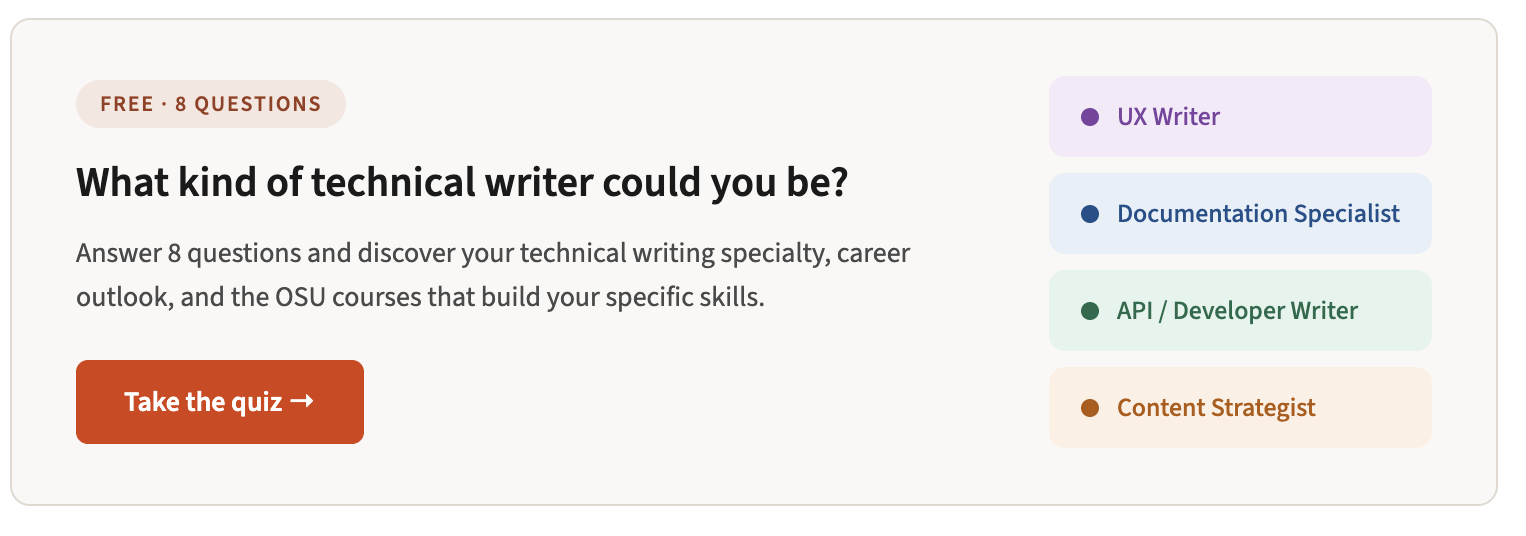
More than half of the people who take our quiz match Documentation Specialist first, and nearly 3 in 4 have it in their top two. Most also show a strong second path in UX writing, content strategy or API writing. This program builds the base for all of them.
AI is changing how documentation gets made, but someone still has to make it accurate, organized and usable. That means checking technical facts, understanding the audience, testing whether instructions work, and taking responsibility for the result. This certificate builds those skills, so they stay valuable as the tools keep changing.
 Read how our Technical Writing Certificate helped Samantha Edington launch herself into a successful new technical writing career.
Graduates of the Technical Writing program have landed roles including:
Free courses and quick video programs can teach the basics. This certificate adds what they leave out: a person who reads your work, and proof you can do the job.
160 hours
of instruction, roughly $16 per hour including registration.
Every week
an OSU writing instructor reviews your assignment and gives feedback.
1 portfolio
built from your own work and ready to share with employers.
16 CEUs
and a non-credit certificate from Oregon State University.
AmeriCorps Education Awards are accepted. See all funding options.
After the certificate, technical writing skills carry straight into building training content: see the Articulate Storyline and Rise Certificate and the E-Learning Instructional Design and Development Certificate.
It's a non-credit university certificate from Oregon State with 16 CEUs. No license or industry certification is required to work as a technical writer. What employers look at most is your writing, which is why the program ends with a professional portfolio.
The full certificate is $2,495 (+$70 registration fee). You can also take any course on its own for $499 (+$70 registration fee). The price is the same wherever you live.
No. There are no prerequisites, and newcomers are welcome. If you're brand new to technical writing, start with the Free Intro to Technical Writing.
Five four-week courses. They don't run back to back, so most students finish in under a year. Assignments are due weekly, with no set class times or live meetings.
Learn on Your Schedule, With Real Support
Life doesn’t stop for class time, so our courses don’t ask you to stop for them either. Every asynchronous instructor-led course has a clear start and end date, but within that window, you’re in control. Log in early in the morning, after the kids are asleep, or on your lunch break: whatever works for your week.
Each week brings new assignments, readings, or videos, with deadlines to keep you moving forward. And you’re never doing it alone. A real instructor reviews your work, offers personalized feedback, and answers your questions as you go.
Most learners spend just a few hours a week on coursework, fitting it around jobs, family, and everything else life throws at them. Flexible doesn’t mean unstructured, and self-paced doesn’t mean unsupported. You get a clear path forward and an expert in your corner the whole way.
Have questions? Request more information. Ready to start? Register now.


 Enjoy peace of mind with our risk-free guarantee on online instructor-led courses.
Start Free
Not ready to commit? Try the self-paced Free Intro to Technical Writing. It takes about 2 to 10 hours.
No Degree. No Set Class Times.
No prerequisites, no live meetings, and the same price anywhere in the world.
The online technical writing courses don’t focus intensely on any specific tools in this program. Rather, the focus is on the writing itself and how to produce high-quality technical writing. This isn’t to say that the course does not discuss the common tools that are used, but rather it does not spend time training on them.
The projects in the online Technical Writing program are self-contained, you will not need to collaborate for group work or to find an external individual to work with.
The Technical Writing program costs the same regardless of where you are from. And there are no restrictions on location, so you can complete this certificate anywhere in the world.
The technical writing series is entirely asynchronous, which means there are no specific dates or times when you need to be online and there are no live meetings. There are assignments due weekly that can be completed at any time during the week prior to their due date.
Newcomers to the technical writing field are welcome and encouraged to complete the certificate program. If you are brand new to technical writing, it is recommended you take the free, self-paced Intro to Tech Writing course first.
The online Technical Writing Certificate is entirely asynchronous, which means there are no specific dates or times when you need to be online and there are no live meetings. There are assignments due weekly that can be completed at any time during the week prior to their due date.
Each Technical Writing Course is four weeks long, and there are five courses in the program. However, the courses do not typically run back-to-back, so you will not be in class for 20 weeks straight. Students typically finish this program in a little under a year and gain their certificate in technical writing.
Anyone is welcome to join the program and there are no prerequisites. All you must do to participate is register.
All five courses are required to receive your certificate in technical writing. You are not required to take all the courses in the series, but you must complete all of them to earn the certificate. Please note that you may not take the Portfolio course until after you have completed the four core courses.
Due to the technical writing program's popularity, we typically extend the registration date for a week after the course begins. However, once each course reaches capacity, the registration window effectively closes.
This certificate program is a non-credit program. Though it is taught by OSU instructors, a degree is not needed to register. So, even though a degree is not needed, it can be ideal for someone looking to supplement their degree.
The Technical Writing Certificate is fully online and can be completed in 6–9 months, depending on your pace.
According to the U.S. Bureau of Labor Statistics, technical writers earn an average of $91,670 annually, with steady growth projected.
"I definitely feel more confident about technical writing after deciding to take this course. Technical writing is an important field of communication that should not be neglected by anyone wishing to broaden their skills in today's high-tech work place. The class is presented in a clear, straight-forward and professional manner. Kudos to Rich Collins for his ability to make a specialized field of writing accessible to anyone."
"The instructor was awesome. She replied promptly to my inquiries and was always ready to help with any problems. Her grading was quick and almost immediate. helpful"
"This course was great - I really, really enjoyed it. The learning materials were focused and applicable. Best part? I looked forward to the weekly modules and assignments. I felt that I learned something new, could apply it directly to each weekly assignment (reinforcement) and then immediately apply it to the writing I do at work. Adult learners tend to want to know, "What's in it for me?" For me, the fact that the concepts and techniques applied immediately to my job meant a lot. No wasted time; just focused instruction."